I am a storydweller. I like to inhabit stories. A crucial aspect of the art of the story is that it takes place over time. There are a sequence of events which follow one after the other. The order of events is not necessarily chronological. The order of events is story-logical. If you mess up the order of events, you mess up the story.
When it comes to the gospel narrative the church has come up with one, very powerful, way of telling the story using our calendar. We have liturgical seasons which follow the order of the story events. If we skip a season or do them out of order it destroys the story. Since most people don't come for worship on days like Ash Wednesday, Maundy Thursday, and Good Friday they are getting botched versions of the story. They skip straight from Palm Sunday to Easter. Or maybe from Christmas to Easter. This doesn't just diminish the days they missed, this completely undermines Easter.
As such I sympathize with the movement to turn Palm Sunday into "Passion Sunday" in many churches. I don't like it. It is truncating the story in a different way, less damaging, but still inelegant. But if only a few people come on Good Friday then only a few people are getting the full impact of Easter Sunday, so "Passion Sunday" makes sense.
Ultimately, though, I think it is a shame not to really milk this season for its spiritual liquor. It takes having a parade on Palm Sunday, prayers all week, a communal meal on Thursday, and mourning all day Friday and Saturday, for Easter to really come alive. Only once you've lived in a world where God is Dead, can you truly hear the good news that he is risen. It's a story. It can't be glimpsed from a distance. It is meant to be dwelled in.

Wednesday, March 31, 2010


Tuesday, March 30, 2010
If I Were President - The Budget
Disclaimer: I know I'm never going to be President of the United States, nor would I truly want to be. I also know much of what I'm going to say in this hypothetical musing is impractical and improbable to say the least. Get over it.
The President does not write the budget- congress does. But the President makes budget requests, gets to veto the budget if he/she doesn't like it, and is charged with keeping much of the budget that congress eventually delivers. In practice, most recent Presidents have had a strong hand in shaping the budget that comes out of congress. Knowing in advance that I would have to compromise and would not get it all my way, here would be my budget priorities:
I would want to decrease or even eliminate the national deficit primarily by dramatically cutting military spending. The military-industrial complex was kicked into high gear during WWII and it never got shut down. In all previous wars the spending increased for a short time and then was heavily cut back afterward. Not after WWII though and never since. Military spending has increased every year since then. It is out of control. Here is the conservative in me coming out - we should not have a standing army. Individual states should have militias and if congress decides it is necessary to go to war we should create the army through conscription.
Military spending is out of control, but it certainly isn't the only place we could make cuts. I would aim for a freeze on the salary of anyone and everyone in government who makes $100,000 or more. I would ask every office and branch for creative solutions in reducing wasteful spending. Can we do more video conferences and lower travel expenses? etc...
More than cutting costs within individual agencies I would want to take a close look at agency redundancy. Homeland Security? Gone. Solving a bloated bureaucracy that doesn't communicate well by creating the largest bureaucracy ever to oversee the others was a dumb idea. FBI, CIA, NSA, DEA, EPA, FDA, FCC and so on... merge them and pare them down. Perhaps create two agencies, one concerned with law enforcement & security, the other a regulatory body for overseeing various industries. In the first year of my presidency I would demand reports from every employee of every department justifying their job. I'd have a logistics and organization planning team going over all of these reports and determining the most efficient way to restructure, eliminating as much redundancy as possible.
To offset the many jobs that would be lost and the impact on our arms industry, I would invest in other areas of the economy. For example, I would aim to lower class sizes in schools by providing funding for more teacher's salaries (teachers, not administrators!). I would create jobs in construction and contracting by spending money on infrastructure, especially efficient mass transit. I would create jobs in the health care sector with a well-funded public option. I would provide federal money to pay for education for doctors and nurses to eliminate the shortage we currently have. I would create jobs in the sciences by increasing the amount we give for research. I would create jobs in the arts the same way.
In fact, one core responsibility of my logistics and organization planning team would be creating a temporary agency for job placement for all of the people formerly employed in the military, the arms industry, and various bloated government agencies, in new jobs created in the fields I described above. It would confound progressives and conservatives alike that when my tenure was finished more people would be employed in the private sector and government would be smaller than it has been in 50 years.
The President does not write the budget- congress does. But the President makes budget requests, gets to veto the budget if he/she doesn't like it, and is charged with keeping much of the budget that congress eventually delivers. In practice, most recent Presidents have had a strong hand in shaping the budget that comes out of congress. Knowing in advance that I would have to compromise and would not get it all my way, here would be my budget priorities:
I would want to decrease or even eliminate the national deficit primarily by dramatically cutting military spending. The military-industrial complex was kicked into high gear during WWII and it never got shut down. In all previous wars the spending increased for a short time and then was heavily cut back afterward. Not after WWII though and never since. Military spending has increased every year since then. It is out of control. Here is the conservative in me coming out - we should not have a standing army. Individual states should have militias and if congress decides it is necessary to go to war we should create the army through conscription.
Military spending is out of control, but it certainly isn't the only place we could make cuts. I would aim for a freeze on the salary of anyone and everyone in government who makes $100,000 or more. I would ask every office and branch for creative solutions in reducing wasteful spending. Can we do more video conferences and lower travel expenses? etc...
More than cutting costs within individual agencies I would want to take a close look at agency redundancy. Homeland Security? Gone. Solving a bloated bureaucracy that doesn't communicate well by creating the largest bureaucracy ever to oversee the others was a dumb idea. FBI, CIA, NSA, DEA, EPA, FDA, FCC and so on... merge them and pare them down. Perhaps create two agencies, one concerned with law enforcement & security, the other a regulatory body for overseeing various industries. In the first year of my presidency I would demand reports from every employee of every department justifying their job. I'd have a logistics and organization planning team going over all of these reports and determining the most efficient way to restructure, eliminating as much redundancy as possible.
To offset the many jobs that would be lost and the impact on our arms industry, I would invest in other areas of the economy. For example, I would aim to lower class sizes in schools by providing funding for more teacher's salaries (teachers, not administrators!). I would create jobs in construction and contracting by spending money on infrastructure, especially efficient mass transit. I would create jobs in the health care sector with a well-funded public option. I would provide federal money to pay for education for doctors and nurses to eliminate the shortage we currently have. I would create jobs in the sciences by increasing the amount we give for research. I would create jobs in the arts the same way.
In fact, one core responsibility of my logistics and organization planning team would be creating a temporary agency for job placement for all of the people formerly employed in the military, the arms industry, and various bloated government agencies, in new jobs created in the fields I described above. It would confound progressives and conservatives alike that when my tenure was finished more people would be employed in the private sector and government would be smaller than it has been in 50 years.
Monday, March 22, 2010
Unanimous!

This is another Hagler celebrating his own victory, but you get the idea.
Last Saturday I was examined by Muskingum Valley Presbytery and they voted unanimously for me to be ordained a Minister of Word and Sacrament. The ordination service is on April 11th and both Friars and the Fool will of course be involved, as will be a number of other people.
Not only was the vote unanimous, apparently, but there were a number of people who were really happy with me. I did not expect that at all. Being that I perceive myself as living in an outpost at the edge of Presbyterianism, I was not expecting a warm welcome, but I got one. I'll be curious to see, from the inside, how far beyond the pale I really am, or whether the Internet just attracts crazies who like to post on blogs. ::wink wink::
Now, of course, some people were not happy with some of my answers during the examination. But I find that what I really want to do is to go talk to them at the next meeting, or between meetings, and get to know them, and find out more about what was behind their questions.
I didn't realize how much this whole process was weighing on me until that last vote. My spouse even cried tears of relief.
For future reference, I look forward, very much, to having all of these engaging, knock-down-drag-out arguments about theology with my colleagues. Particularly in MVP, which I am finding to be a really superb Presbytery. I never thought I'd look forward to the next Presbytery meeting, but I actually am.
Anybody else seen these flying pigs?
Tuesday, March 16, 2010
Work, Play, Obligation, Joy
 All work and no play makes Jack a dull boy. - American saying
Work before play. - My Dad (and yours too probably)
Nowadays it is conventional wisdom that if you can you should make your hobby into your career. Do what you love. That is what parents are supposed to teach their children. It is what we are told at transitional stages of our lives such as the end of high school or college education. We are supposed to find joy in our work. Work and play are not supposed to be either or, any longer. We are allowed to have our cake and eat it too.
Are we though? Is that just the position of unbelievable privilege? Is it a kind of blindness that we believe every person should be allowed to get paid full time to do something they enjoy? Who would do the data entry then? Who would clean toilets?
On the other side is our deeply rooted "protestant work ethic" which tells us that there are certain things in life one just has to do. No certainties but death and taxes. Bills must be paid. Food must be bought (or grown). Toil is inevitable. For a great many, toil is not only inevitable, but heavy and constant.
Furthermore, there is a kind of joy to be found in hard work as our puritan forbearers attested. Plenty of artists are supposedly in exactly the position we tell our kids to seek - getting paid to do something they love - and yet they are miserable.
What is the the relationship of these things? Is play a privilege? A right? Is work a means to an end or an end itself? Is obligation the antithesis of joy or is there some other interaction between these things? Is there an answer that doesn't sound either fatalist "accept your plight and learn to like it" or myopic and arrogant "it's the right of every white, middle-class, American to be prosperous and happy?"
Friday, March 12, 2010
If I Were President - The Great Pardoning
Disclaimer: I know I'm never going to be President of the United States, nor would I truly want to be. I also know much of what I'm going to say in this hypothetical musing is impractical and improbable to say the least. Get over it.
The POTUS has a lot of power in our system - much more than in most democracies or constitutional republics. Many of the President's powers require congressional rubber stamping, but plenty of them don't. One heavily under-utilized example is the presidential pardon. The President may without rhyme or reason pardon or commute the sentence of anyone convicted of any crime anywhere in the country. Heck, they don't have to be convicted even. You can pre-emptively pardon.
Here is what I would do. Starting on day one of my presidency I would have lists drawn up of every convicted criminal in the country. I would have them categorized into types of offenses and their severity. I would then begin mass pardoning from the least dangerous on upward, with the ultimate goal being emptying our prisons of all but the most dangerous and violent types of criminals.
This would commence in waves for several reasons.
Practically speaking it would be too much work to accomplish in one big push.
A whole bunch of ramifications would result from the sudden influx of unemployed, homeless, former convicts. I would want to give communities time to adapt. Alongside the pardons I would call on aid organizations, churches, and others to get together and strategize how to integrate these people back into society.
I would use the waves as pressure on Congress to demand several things. I would demand legislation aimed at creating jobs and assisting freed prisoners in establishing new lives. I would ask to reorient law enforcement offices around the country in the direction of rehabilitation & prevention rather than punishment. I would demand an end to the war on drugs and changes to federal and state standards for imprisonment - promising to continue pardoning until satisfactory changes were implemented. Each delay would see a new wave of pardons.
I would assemble teams to analyze batches of cases where it would be appropriate to commute sentences rather than pardon if a better result could be achieved. Can murderers and sex offenders be treated psychologically (even permanently in a mental health facility if necessary) rather than imprisoned? Would some benefit from community service? I would commute every single death sentence to a lesser penalty immediately.
Against the threat of impeachment (since this would outrage many people) I would reserve the "nuclear pardon" option to pardon every single prisoner at once on my last day in office if impeached. So long as it remained possible I would continue the slower, more judicious method of pardoning in waves.
By the end of my term I would hope to have very nearly emptied our prisons entirely. Only a small fraction of those currently imprisoned would remain because a better solution could not be found. As such I would hope to crush the prison economy irrevocably. I would relentlessly pressure states and congress to change their laws to utilize alternate forms of punishment beside imprisonment and to create new jobs in social services aimed at overseeing the new procedures of crime and rehabilitation. A few federal prisons would remain as relics for desperate cases where society utterly failed to come up with a better solution.
The POTUS has a lot of power in our system - much more than in most democracies or constitutional republics. Many of the President's powers require congressional rubber stamping, but plenty of them don't. One heavily under-utilized example is the presidential pardon. The President may without rhyme or reason pardon or commute the sentence of anyone convicted of any crime anywhere in the country. Heck, they don't have to be convicted even. You can pre-emptively pardon.
Here is what I would do. Starting on day one of my presidency I would have lists drawn up of every convicted criminal in the country. I would have them categorized into types of offenses and their severity. I would then begin mass pardoning from the least dangerous on upward, with the ultimate goal being emptying our prisons of all but the most dangerous and violent types of criminals.
This would commence in waves for several reasons.
Practically speaking it would be too much work to accomplish in one big push.
A whole bunch of ramifications would result from the sudden influx of unemployed, homeless, former convicts. I would want to give communities time to adapt. Alongside the pardons I would call on aid organizations, churches, and others to get together and strategize how to integrate these people back into society.
I would use the waves as pressure on Congress to demand several things. I would demand legislation aimed at creating jobs and assisting freed prisoners in establishing new lives. I would ask to reorient law enforcement offices around the country in the direction of rehabilitation & prevention rather than punishment. I would demand an end to the war on drugs and changes to federal and state standards for imprisonment - promising to continue pardoning until satisfactory changes were implemented. Each delay would see a new wave of pardons.
I would assemble teams to analyze batches of cases where it would be appropriate to commute sentences rather than pardon if a better result could be achieved. Can murderers and sex offenders be treated psychologically (even permanently in a mental health facility if necessary) rather than imprisoned? Would some benefit from community service? I would commute every single death sentence to a lesser penalty immediately.
Against the threat of impeachment (since this would outrage many people) I would reserve the "nuclear pardon" option to pardon every single prisoner at once on my last day in office if impeached. So long as it remained possible I would continue the slower, more judicious method of pardoning in waves.
By the end of my term I would hope to have very nearly emptied our prisons entirely. Only a small fraction of those currently imprisoned would remain because a better solution could not be found. As such I would hope to crush the prison economy irrevocably. I would relentlessly pressure states and congress to change their laws to utilize alternate forms of punishment beside imprisonment and to create new jobs in social services aimed at overseeing the new procedures of crime and rehabilitation. A few federal prisons would remain as relics for desperate cases where society utterly failed to come up with a better solution.
Tuesday, March 9, 2010
Reflections on The Scots Confession
Skipping ahead a thousand full years, during which I'm sure nothing whatsoever of interest happened in Christendom, we come to the Scots Confession. With these longer confessional documents, I'll be reading through and then commenting on what strikes me one way or another as I read. For those of you following along at home, I'll be including numerical references.
3.02 I find that the Scots Confession says a lot more about the creation stories in Genesis than Genesis itself does. According to the SC, "our first father" Adam is created and endowed with "wisdom, lordship, justice, free will and self-consciousness, so that in the whole nature of man no imperfection could be found". Precisely none of these things are supported by Genesis. The 'adam is given a shape, the breath of life, and the power to give animals names. Then the 'adam is split into two and becomes Adam and Eve. Nowhere that I recall in the story is Adam described as without any imperfection. This is, of course, the classic set-up for the Fall, which comes next, but like must of the theology around the Fall, does not really have much Biblical support.
3.03-3.04 This perfect image of God present in Adam and Eve is certainly profoundly fragile, because it is "utterly defaced" by one act of disobedience. Again, this is not a claim made in Genesis, but it is made in the SC. In Genesis, as I recall, the penalties for disobedience are pain in childbirth, inequality between the sexes, having to toil on the land to get food, and exile from Eden forever. There is no ontological defacement mentioned that I recall.
One of the most important things about Genesis is not mentioned, and wasn't really focused on (that I'm aware of) until the rise of historical criticism - that we were created to be gardeners, frolicking around and eating fruit without a care in the world. This is in contrast to other creation myths like the Babylonian ones, where humanity is created to serve the gods, and of course the king, as servants and slaves.
A catastrophic fall from grace is not presented as the result of the disobedient eating in Genesis - but pain, work and patriarchy are. As well as snakes having no legs.
Only later does the observation of total depravity lead one to look backward and impose the SC interpretation onto Genesis.
3.07 Chapter 7, titled "Why the Mediator Had to Be True God and True Man", is only one sentence long. It is written here that the answer to the question that the chapter poses is that the Mediator could not otherwise due to the "immutable decree of God". I am actually under the impression that the Incarnation was a tough sell for everyone, including the Jewish communities of the ancient world, and so I'm wondering where this decree can be found and why almost no one was aware of it?
3.08 It is very interesting to find here in the discussion of the atonement clear references to the Christus Victor theology mingled with penal substitutionary atonement. This is a lot more true to the Bible which does not present one concise explanation for how the atonement is achieved but rather a number of explanations, metaphors, images and so on. Of these, penal substitutionary atonement has always made the least sense to me by far, but it's hard to deny that one could draw that conclusion. It's just impossible to make a strong argument that penal-sub is the only conclusion.
3.11 Under the chapter heading "The Ascension" we read a lot about the Day of Judgement, and I must differentiate myself again on at least one point. We have the usual theology of election here, and it is presented as not only a bridle for carnal lusts but also an inestimable comfort, and I want to be clear that the idea that all unbelievers being cast into an eternal prison of darkness, worms and fire is anything but a comfort. Not only might I, or anyone reading this, be cast into the prison if we happen to be missing the right beliefs, but billions will be locked into eternal torture for nothing more than an accident of birth. This is not a comfort; this is a looming threat.
Not to mention that if the word "love" has any meaningful content whatsoever, that content must include 'not condemning people to eternal torment', whatever theological contortions one proposes based on God's justice and God's love being somehow at odds.
But this is well-trodden material with the Friars and Fool.
3.12 Ok, here's another great argument against the justice of eternal damnation - the theology of the Holy Ghost, which says that apart from the HG we have no capacity to perceive, understand or respond to truth and God's love for us. What this means is that if there are non-believers, it cannot be the fault of the non-believer, right? Isn't it just that the HG has quickened knowledge of God in some and not in others? How then can we be both unable to respond to God and also eternally deserving of punishment for not responding to God?
In a word, Arg.
3.13 I'm having more trouble with this antropology than I'd expected. In the chapter on "The Cause of Good Works" the claim is made that those who are not Christians and how commit misdeeds have no regrets when they do so because they are simply following their sinful natures.
Given that almost everyone, apart from sociopaths or the deranged, feel guilt and regret for their misdeeds much of the time, I can only draw two conclusions.
1. The Scot's Confession is incorrect in it's absolutizing of our sinful natures, or
2. Almost everyone has Christ in them, manifesting as their conscience.
In fact, isn't the conscience one of the 'proofs' of God that Paul mentions which convicts everyone, even non-believers, of their sinful nature? This Pauline assertion seems to contradict the Scots Confession on this point.
3.14 A breath of fresh air is found in the SC's definition of good works - either they honor God or they profit our neighbor. Sounds about right to me. Good is either good in and of itself or good because it is beneficent.
Just to belabor a point, eternal punishment is not good on either count.
3.15 On the Law, in brief. If perfectly followed, it functions perfectly, but for human beings it is impossible to follow perfectly. In this view, the Law is nothing but an engine for infinite condemnation.
It should be noted that this is not what the authors of the Pentateuch thought the Law was, this is what Paul thought the Law was. For Jews, the Law (Torah) is the standard of righteousness, but there is no expectation that human beings will follow it perfectly. That is why there is all that talk of God forgiving all the time. The Torah binds the people of God to God in reciprocal relationship - it is not an infinitely high pole that no one can ever vault.
3.18 I wonder whether the third sign of the true Kirk, that "vice is repressed and virtue nourished", can be leveraged now to support developing virtue ethics in the Protestant Church. Since we're a lot less concerned with differentiating ourselves from the "pestilent Papists", perhaps we can come up with some sort of system whereby vice is actually repressed and virtue is actually nourished.
Here we also have the Holy Spirit as the true interpreter of scripture along with the idea that scripture should be interpreted with reference to scripture, preferencing the words and actions of Christ. The three measures of interpretation given are the principal points of faith, the plain reading of scripture, and the rule of love. This is delightful, since what are the principal points of faith, what is a plain reading of scripture, and what constitutes love are of course...to be interpreted.
3.21 I am finding that I really enjoy the sacramental theology of the SC presented here, and this is part of what I want to promote at my own new church, what I have seen function so powerfully particularly in multicultural worship.
3.24 A little sprinkle of idolatry here, frankly, in the section on political powers and authorities, all but equating them with God's authority. Now, of course, the Kirk itself was making a bid for political power and authority in the vacuum left by the Catholic Church, so it isn't surprising that they would side entirely with the rules and never against those who resist their rulership.
As we all know, Jesus never condoned civil disobedience of any kind, and always attributed the highest intentions to those in authority. He never questioned those with political authority. Nope. Not Jesus.
3.25 For the concluding chapter, I wish there was anything about sanctification in here. Ah well.
Monday, March 8, 2010
Reflections on The Apostle's Creed
Not written by apostles, but taken to reflect their beliefs, it only took about 300 years and two continents to complete. It plays no role in Eastern Orthodoxy, but grew up in Rome, north Africa and Gaul (France) before it was born in it's current form.
2.1 Again God is "the father almighty, maker" and that's all that is said. God is a familiar character we've seen a lot before, and here all we learn about God is that God has all the power, is like a father, and makes. Interestingly, to me, the "making" implies the use of pre-existing material, does it not? I sort of picture God in the basement workshop, emerging covered in sawdust and sweat, cradling a world in his hands.
2.2 Without the Nicene commentary on Jesus' nature, we get his highly abbreviated resume, which is that he was conceived, born (to a "virgin" of course), died, raised and will judge. Interestingly, in this formulation, we skip almost everything that Jesus said was important about himself and his teachings in the Gospels. The abbreviated version, sticking presumably to the most important facts, doesn't have Jesus really doing anything until the judging the quick and the dead starts - and that has not even started yet. The rest just sort of happens to him.
2.3 Most paltry is "I believe in the Holy Ghost" - no hint as to who that is, except that the statement is followed by mention of the church, the saints, forgiveness, resurrection of the body and everlasting life. The implication is that, at best, the Holy Ghost is involved in these things somehow.
Saturday, March 6, 2010
Explaining Religion to the Hollywood Generation
...whatever the "Hollywood generation" is, I thought this was pretty funny. When I found it, it had already been divorced from it's original author - if someone can attribute it, I'd be happy to add the attribution.
“Think of it like a movie. The Torah is the first one, and the New Testament is the sequel. Then the Qu’ran comes out, and it retcons the last one like it never happened. There’s still Jesus, but he’s not the main character anymore, and the messiah hasn’t shown up, yet.
Jews like the first movie but ignored the sequels, Christians think you need to watch the first two, but the third movie doesn’t count. Muslims think the third one was the best, and Mormons liked the second one so much they started writing fan fiction that doesn’t fit with any of the series canon.”
Friday, March 5, 2010
Reflections on The Nicene Creed

Written to support Constantine's agenda of "One God, one Lord, one faith, one church, one empire, one emperor", the Nicene Creed is the first formulation of imperially-sanctioned Christianity. As such, it is accepted by all imperial powers, from Rome to the United States - described as the most ecumenical. What of the writings of the Church before it became wedded to political and military power? Not as 'ecumenical', I suppose.
Interesting, to me, that before empire 'ecumenical' meant diverse and lively and internally conflicting. In the midst of empire, 'ecumenical' means "most widely enforced". If Christianity had never been handed the sword, I wonder what ecumenical would mean now? What it could mean again, after the inevitable fall of our own empire?
The conversion of Constantine and the Roman Empire are at the top, or near the top, of my list of Worst Things to Happen to Christianity. But it is where the Book of Confessions begins.
1.1 'Maker...of all things visible and invisible.' I have always wondered whether this means "perceptible and imperceptible" or whether it literally means "invisible", as in sound waves and concepts and gamma radiation. I tend to assume that it is referring to perceptible and imperceptible, since that would be necessary for God to be maker of "all things".
1.2 Compared to the little bit said about God, Jesus Christ gets a lot of commentary. I go with the assumption that, in cases like this, more is said because more must be said. If there was not disagreement, that is, then this could have been as short as 1.1. Interestingly, a point is made to have Jesus as being of one substance as the father, earlier defined solely as "maker", and the 'making part is repeated. It is interesting to me that given the trinity, we still give Jesus by far the most attention and have the most relational terms between Jesus and God. In contrast, the Holy Spirit is either talked about as itself or as subordinate to God or Jesus - it is "the Spirit of Christ" or "the Spirit of God" but we never say "God of the Spirit" or "Christ of the Spirit", "Son of the Spirit" and so on.
1.3 Here it is, the Holy Spirit "who proceedeth from the Father and the Son". The subordination here is ameliorated by talking about how the Spirit is to be worshiped just as God and the Son are, but immediately we go to the apostolic Church, which in the creeds is often the purview of the Spirit. Given that the Church is also the bride of Christ, accepting Christ as head and leader (the patriarchal view of a proper "bride"), the subordination is hard to ignore.
In short, it is hardest to talk about the Spirit. The Spirit does not have a personal shape like Jesus, and God is such a broad character at this point (existing in every monotheism as well as many civic religions); the Spirit is the ineffable one of the trio. Fires, smoke, clouds, doves, voices, invisible presences, breath on waters, the Incarnator...a lot harder to nail down, and so a lot of our traditional language just subtly places the Spirit below God and Jesus in majesty and in function with the occasional caveat.
For this reason, I think that reasonable Reformed Theology shies away from a robust theology of the Spirit. For that, we'd have to let the mystics and poets in the door. We'd have to learn to say "I don't know". And surely that's not what theology - or empire - is about.
Wednesday, March 3, 2010
Preaching is Hard... & it is Easy
There's a good post about the difficulties of preaching over at Shored Fragments.
He makes a solid point - it is pretty tough to have something worthwhile to say on a weekly basis to the same group of people. We don't expect that of many other professions. Most professional speakers and experts repeat the same message to different people even if they speak weekly. Broadcasters who speak a lot, and sometimes to the same audience, do it with a team of researchers and writers at their disposal. A minister is usually on their own. Grab a Bible, sit at your keyboard, write something poignant - go. Now do it again and again and again.
So, yeah, I agree: preaching is hard.
And it is also easy.
It is easy because we don't have to preach an entirely new message every week. We preach the same message in a slightly different way. What is required is a facility with language and metaphor, not a bottomless supply of new ideas and information.
It is easy because sermons grow organically out of your life together in the church. I don't have to pull a sermon out of thin air, I talk about what naturally arises in the course of daily life.
It is easy because we are not held to an absurd standard of polish and rhetorical brilliance. Not every sermon has to be a masterpiece. If you kill yourself over every syllable it will be forgotten just as quickly as if you improvise the entire thing. Being faithful to your purpose in preaching is more important than any amount of technical mastery.
It is easy because there are straightforward techniques one can practice and master with time. Writing is not a mysterious artform. Public speaking is even less mysterious. Practice elocution, pith, and delivery. You will get better.
He makes a solid point - it is pretty tough to have something worthwhile to say on a weekly basis to the same group of people. We don't expect that of many other professions. Most professional speakers and experts repeat the same message to different people even if they speak weekly. Broadcasters who speak a lot, and sometimes to the same audience, do it with a team of researchers and writers at their disposal. A minister is usually on their own. Grab a Bible, sit at your keyboard, write something poignant - go. Now do it again and again and again.
So, yeah, I agree: preaching is hard.
And it is also easy.
It is easy because we don't have to preach an entirely new message every week. We preach the same message in a slightly different way. What is required is a facility with language and metaphor, not a bottomless supply of new ideas and information.
It is easy because sermons grow organically out of your life together in the church. I don't have to pull a sermon out of thin air, I talk about what naturally arises in the course of daily life.
It is easy because we are not held to an absurd standard of polish and rhetorical brilliance. Not every sermon has to be a masterpiece. If you kill yourself over every syllable it will be forgotten just as quickly as if you improvise the entire thing. Being faithful to your purpose in preaching is more important than any amount of technical mastery.
It is easy because there are straightforward techniques one can practice and master with time. Writing is not a mysterious artform. Public speaking is even less mysterious. Practice elocution, pith, and delivery. You will get better.
Wednesday, February 24, 2010
If I Were President - Radical Ethos
Disclaimer: I know I'm never going to be President of the United States, nor would I truly want to be. I also know much of what I'm going to say in this hypothetical musing is impractical and improbable to say the least. Get over it.
Since I'm so good at criticizing politicians it is fair if once in a while I make an attempt to say what I would do in their place. This is too big a subject to cover in one post, but I'm not starting a series here either. So no promises about regular posting on this topic. As I feel moved I will throw out posts to elaborate on different political topics and the approach I would take, hypothetically, if I were President. Feel free to call me crazy in the comment threads.
In this first post I want to talk about the "ethos" of my presidency.
As president I would not spend one second of one day thinking about re-election or anyone else's election. I would forbid my staff and anyone in my vicinity from conducting, following, analyzing or discussing polls. I would expect to be committing political suicide and would therefore waste no time wondering if I could do things to make others happier.
In keeping with this ethos I would not spend very much effort attempting to feign bi-partisanship, or partisanship for that matter. I would make my intentions very clear and then invite any who want to help to join paying no attention to their political affiliations, and dare any who oppose me to do their best. I would expect to fail on a number of my initiatives and therefore wouldn't promise much except absolute integrity.
There would be no half-measures. I would not wait for the opportune moment, or avoid politically sensitive matters, or accept bad compromises. In fact, I would intentionally over shoot hoping reality to come closer to my actual goals than if I were to approach them hesitantly. I would attempt to outrun, out-think, and out-flank my detractors by simply overwhelming them with so much to get in a tizzy about that they wouldn't know where to begin. I would ambush the country with ideas so radical that for 50 years we would elect hippies believing them to be conservative.
I would be relentless in attacking bad policies on moral grounds. I would not cede the conversation about morality to those obsessed with gay marriage, but would ceaselessly confront congress about poverty, warfare, and greed. I would readily accept criticism made on similar grounds of my own behavior. I would apologize publicly and frequently.
Essentially, I would strive to absolutely flabbergast everyone. In fact, that is the plan because I would use that shock and surprise to reorient expectations. I would make swift and liberal use of presidential powers such that my successors could work for decades to undo it all and not finish. I would consider it an experiment in politics divorced from cynical realism; an attempt to see whether it is possible to shake the rust off of our system of government and actually accomplish meaningful change.
You want examples? You'll have to wait for my next post.
Since I'm so good at criticizing politicians it is fair if once in a while I make an attempt to say what I would do in their place. This is too big a subject to cover in one post, but I'm not starting a series here either. So no promises about regular posting on this topic. As I feel moved I will throw out posts to elaborate on different political topics and the approach I would take, hypothetically, if I were President. Feel free to call me crazy in the comment threads.
In this first post I want to talk about the "ethos" of my presidency.
As president I would not spend one second of one day thinking about re-election or anyone else's election. I would forbid my staff and anyone in my vicinity from conducting, following, analyzing or discussing polls. I would expect to be committing political suicide and would therefore waste no time wondering if I could do things to make others happier.
In keeping with this ethos I would not spend very much effort attempting to feign bi-partisanship, or partisanship for that matter. I would make my intentions very clear and then invite any who want to help to join paying no attention to their political affiliations, and dare any who oppose me to do their best. I would expect to fail on a number of my initiatives and therefore wouldn't promise much except absolute integrity.
There would be no half-measures. I would not wait for the opportune moment, or avoid politically sensitive matters, or accept bad compromises. In fact, I would intentionally over shoot hoping reality to come closer to my actual goals than if I were to approach them hesitantly. I would attempt to outrun, out-think, and out-flank my detractors by simply overwhelming them with so much to get in a tizzy about that they wouldn't know where to begin. I would ambush the country with ideas so radical that for 50 years we would elect hippies believing them to be conservative.
I would be relentless in attacking bad policies on moral grounds. I would not cede the conversation about morality to those obsessed with gay marriage, but would ceaselessly confront congress about poverty, warfare, and greed. I would readily accept criticism made on similar grounds of my own behavior. I would apologize publicly and frequently.
Essentially, I would strive to absolutely flabbergast everyone. In fact, that is the plan because I would use that shock and surprise to reorient expectations. I would make swift and liberal use of presidential powers such that my successors could work for decades to undo it all and not finish. I would consider it an experiment in politics divorced from cynical realism; an attempt to see whether it is possible to shake the rust off of our system of government and actually accomplish meaningful change.
You want examples? You'll have to wait for my next post.
Saturday, February 13, 2010
Church Planting Proposal
 For the past 25 years the PC(USA) has had a strategy for planting churches that involves careful demographic studies, long-term investment and gradual development. New Church Developments (NCD's) in our denomination take a long time to get going and cost a lot of money. Without doing a lot of analysis I'll just say that I don't think this strategy is working very well.
Parallel with this NCD situation we have a denomination that has been in pretty steep decline. A large percentage of our churches are small and shrinking. As such they cannot afford full-time ministers who come with a lot of debt out of seminary. Other churches are closing, or leaving the denomination. Furthermore, ministers are working longer into old-age before retiring. However, our 11 seminaries continue to pump out graduates every year. These combined factors have led to a situation where we have thousands of individuals wanting to do ministry with no place to do it. These unemployed potential ministers are often younger, unordained (because they can't get a call), and a lot more of them are women and minorities than their employed counterparts. They represent, in other words, the very demographics that our denomination is failing to reach.
Thus we have two related problems - a failing strategy for planting new churches, and a lack of pulpits for incoming ministers. Could we mitigate (if not outright solve) both with one stroke? I think we could. Here is my proposal:
Instead of NCD's being created by Presbyteries and Synods in a long, slow, expensive process, provide a plethora of small grants to individuals wanting to plant a church. Offer 2-years half-time salary to 300 ministers a year. Prioritize young ministers, women, minorities and others who have a harder time getting into the competitive first call slots. Make them come up with the proposal and go out on a limb with unconventional organizing plans. If in 2-years the NCD isn't viable, move on.
Many of these NCD's will fail, but so do NCD's developed the expensive and slow way. At least this way we will have tested the waters a bit, and employed a large group of our young talent to see if any gems emerge. As it stands we are wasting a huge pool of motivated, educated, potential ministers. The harvest is indeed enormous, but the workers don't have to be as few as they currently are.
I am convinced that we need a more spontaneous, bottom-up, strategy for developing ministries. Once upon a time, to get volunteers and participants you needed to have institutional structures in place. The way to open a church was to build it, hire a minister, and put a sign out front. Now though, all the institutional readiness and stability in the world won't get you members. In fact, who wants to be a "member" of anything? People want to show up where the action is. They want to join a movement; participate in a project; attend an event - not get their name on a roll. It's time for a Church 2.0 where everyone generates the content, and determines the form it takes. Successful church plants are going to be more like memes than clubs.
What if 90% of these NCD's fail? That's 30 new churches this year. And next year. And next year. Meanwhile those other 270 pastors are busy learning important lessons about what works and what doesn't. They will provide important feedback to the denomination as a whole about our church planting strategy. Feedback that is more valuable than what we currently get purely on the basis of quantity. And the whole time they will be employed in our denomination using their gifts for ministry instead of waiting tables, or doing data-entry.
Friday, February 12, 2010
I Love That About Music
I can reject a theology that I read in a book, but if Johnny Cash sings it, I'll nod my head and tap my feet and sing along.
I think that Black theologians a few decades ago were right - songs are a different kind of theological discourse, but no less valuable, than that found in dense scholarly tomes. I think that music acts on different parts of the brain, parts we might share more deeply in common than written discursive language. It might be a way to bridge gaps which weigh heavily on me when I think of them - the preposterous difficulty there is in communicating with other religious people who disagree with me, especially in blogs and blog comment threads. Could I sing them a song about ordination rights for all children of God that they would not their head to? It would be something, maybe. A start.
Wednesday, February 10, 2010
Unfinishing Disease
I have always been an idea person. I have a million ideas jostling for my attention on any given day. I completely ignore the vast majority of them, never even imagining them into any kind of fruition. I know better than to get too invested.
Still, the tiny proportion of this miasma that I pluck out and put some effort into is a lot. Despite cultivating selectivity and striving hard for discipline these past ten years I find that most of the ideas I select and work for come to nothing. The difficulty I have is determining when failure is due to my own lack of follow-through, and when it is because the idea just wasn't ripe for plucking. Hitting walls is inevitable, but at what point is beating my head against a wall just self-abuse rather than admirable determination?
At this moment I have a host of programs in nascent or developmental stages at my Church. I know it is too many, but which ones do I drop? I have 3 different theological writing projects I'd like to be working on. I have an adult Bible Study curriculum I have half-written. I have 2 role-playing games I am collaborating on writing seriously, which I have stalled out on. I want to blog here more. I want to podcast with my fellow friars. I want to get a Lily grant to do something completely awesome and revolutionary for the future of the church.
The point is not to whine about my workload or compare it against anyone else's. What I want to know is how I get out of a position where it feels like everything is in a perpetual state of delayed progress.
Still, the tiny proportion of this miasma that I pluck out and put some effort into is a lot. Despite cultivating selectivity and striving hard for discipline these past ten years I find that most of the ideas I select and work for come to nothing. The difficulty I have is determining when failure is due to my own lack of follow-through, and when it is because the idea just wasn't ripe for plucking. Hitting walls is inevitable, but at what point is beating my head against a wall just self-abuse rather than admirable determination?
At this moment I have a host of programs in nascent or developmental stages at my Church. I know it is too many, but which ones do I drop? I have 3 different theological writing projects I'd like to be working on. I have an adult Bible Study curriculum I have half-written. I have 2 role-playing games I am collaborating on writing seriously, which I have stalled out on. I want to blog here more. I want to podcast with my fellow friars. I want to get a Lily grant to do something completely awesome and revolutionary for the future of the church.
The point is not to whine about my workload or compare it against anyone else's. What I want to know is how I get out of a position where it feels like everything is in a perpetual state of delayed progress.
Thursday, February 4, 2010
Theologically Ghetto-Fabulous
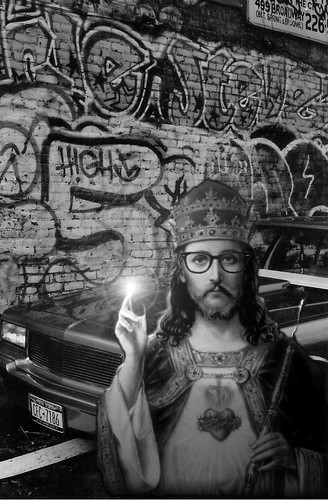
I read about this on Shuck and Jive and it kind of blew my mind.
This is the argument of Presbyterians For Renewal as far as I can tell:
"Unless everyone agrees with us about everything, we cannot possibly live out our mission. We are hindered in proclaiming the Good News if anyone in the PC(USA) does not buy into our theology wholesale. Therefore, we must create a theological ghetto composed only of those who agree with us so that we can begin to move forward with our mission. Otherwise, we are totally impotent to act."
I've never heard of a mission that is so feeble. I wouldn't even require this of parishioners at my own church who I am working with, much less a whole denomination. It is historically unprecedented as far as I know in the Presbyterian Church that one part of the Body would be completely paralyzed unless every other part of the Body agree with it entirely.
What kind of Gospel is this that is so easily derailed? Except for occasional discussions in Presbytery or above, disagreements about the status of homosexuals have no necessary impact whatsoever on our shared ministry - unless one group throws a tantrum and refuses to move forward with anything until there is agreement in everything.
This overture sets a totally untenable precedent - that in order to do our work as believers, we have to create theological ghettos around dogmatic particulars cherry-picked from our tradition...which is not a dogmatic tradition at all! It is a confessional tradition!
This is a perfect example of how orthodoxy can paralyze orthopraxis. For some, we must all assent to the same set of truth-claims before we can start doing what is right. I mean, if we don't agree about homosexuality, how can we agree about how to treat the poor? It is either all or nothing for these people.
"Unless everyone agrees with us about everything, we cannot possibly live out our mission. We are hindered in proclaiming the Good News if anyone in the PC(USA) does not buy into our theology wholesale. Therefore, we must create a theological ghetto composed only of those who agree with us so that we can begin to move forward with our mission. Otherwise, we are totally impotent to act."
I've never heard of a mission that is so feeble. I wouldn't even require this of parishioners at my own church who I am working with, much less a whole denomination. It is historically unprecedented as far as I know in the Presbyterian Church that one part of the Body would be completely paralyzed unless every other part of the Body agree with it entirely.
What kind of Gospel is this that is so easily derailed? Except for occasional discussions in Presbytery or above, disagreements about the status of homosexuals have no necessary impact whatsoever on our shared ministry - unless one group throws a tantrum and refuses to move forward with anything until there is agreement in everything.
This overture sets a totally untenable precedent - that in order to do our work as believers, we have to create theological ghettos around dogmatic particulars cherry-picked from our tradition...which is not a dogmatic tradition at all! It is a confessional tradition!
This is a perfect example of how orthodoxy can paralyze orthopraxis. For some, we must all assent to the same set of truth-claims before we can start doing what is right. I mean, if we don't agree about homosexuality, how can we agree about how to treat the poor? It is either all or nothing for these people.
That is totally absurd! We have to agree about homosexuality before we can feed the hungry? Clothe the naked? Release the prisoners? Love our enemies? Bind up the brokenhearted? Mourn with those who mourn and rejoice with those who rejoice? What kind of foolishness is this?
It is like a Gospel made of paper-thin crystal that will shatter into a million pieces if it isn't handled with kid gloves. It has to be placed in a hermeneutically sealed vault (New Synod) and only handled by people with special training (those who agree with Presbyterians for Renewal on every conceivable theological issue).
It is like a Gospel made of paper-thin crystal that will shatter into a million pieces if it isn't handled with kid gloves. It has to be placed in a hermeneutically sealed vault (New Synod) and only handled by people with special training (those who agree with Presbyterians for Renewal on every conceivable theological issue).
It is not a Gospel that I recognize. They are going to 'embody God's trasformative grace' by being neither gracious nor transformed? This is a brittle Gospel indeed, and I hope no one is fooled into thinking it is the real deal.
Subscribe to:
Posts (Atom)